
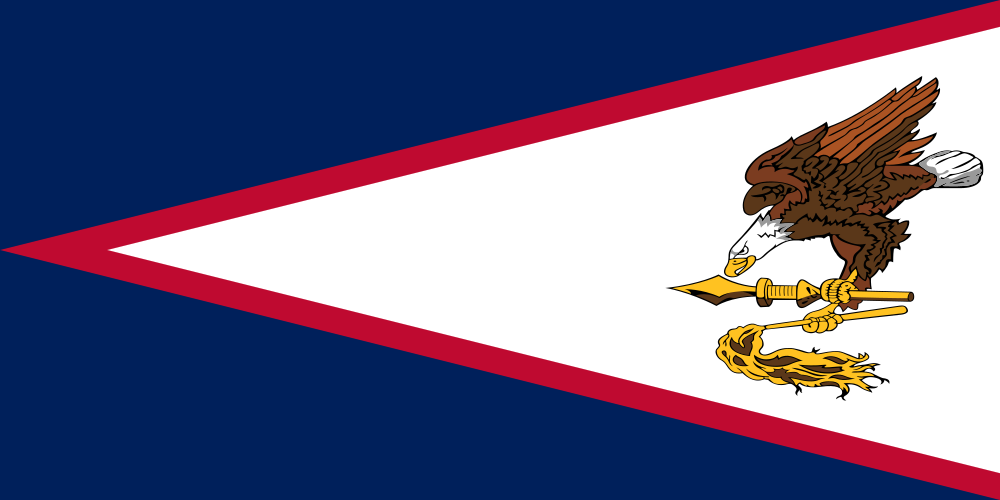
American Samoa Territory: What It Is and Why It Matters
American Samoa occupies a unique and legally complex position within the United States framework — the only permanently inhabited unincorporated territory where native-born residents hold U.S. nationality but not automatic U.S. citizenship. This site provides reference-grade coverage of that framework across 31 in-depth articles, spanning constitutional structure, citizenship and nationality law, economic conditions, federal relationships, cultural identity, and entry requirements. The material is structured for researchers, legal professionals, journalists, policy analysts, and anyone navigating the operational realities of the territory's status.
Scope and definition
American Samoa is an unincorporated, organized territory of the United States located in the South Pacific Ocean, approximately 2,600 miles southwest of Hawaii. The territory consists of 5 main islands and 2 coral atolls, with a total land area of 76 square miles. Pago Pago, on the island of Tutuila, serves as the territorial capital and the site of the only deepwater harbor in the region.
The term "unincorporated" has specific legal significance under U.S. constitutional doctrine. Under the Insular Cases — a series of U.S. Supreme Court decisions issued between 1901 and 1922 — unincorporated territories are subject to U.S. sovereignty but only certain "fundamental" constitutional provisions apply by default. American Samoa is the only U.S. territory where this status has produced a distinct nationality category: persons born there are classified as U.S. nationals under 8 U.S.C. § 1408, not U.S. citizens. This distinction has practical consequences across passport issuance, voting rights, eligibility for federal employment, and access to certain public benefits.
The full legal contours of this status are detailed at American Samoa Territorial Status Explained, which covers the constitutional doctrine, the Insular Cases framework, and the implications of unincorporated status in federal law.
Why this matters operationally
The nationality-versus-citizenship distinction generates concrete administrative consequences at federal and state levels. A U.S. national from American Samoa can travel on a U.S. passport but cannot vote in federal elections and is ineligible for certain federal civilian positions that require citizenship. The 9th U.S. Circuit Court of Appeals addressed this tension directly in Fitisemanu v. United States (2021), and the question of birthright citizenship for American Samoans has been actively litigated without a definitive Supreme Court resolution as of the 2024 judicial term.
Beyond citizenship, the territory's federal funding structure is distinct. American Samoa receives Medicaid funding under a capped block-grant arrangement rather than the open-ended matching formula applied to the 50 states — a structural difference that limits healthcare coverage capacity relative to population need. The territory's economy relies heavily on 2 tuna canneries, which as of 2022 employed approximately 20% of the private-sector workforce (U.S. Department of the Interior, Office of Insular Affairs).
For policy researchers and legal professionals, the operational framework is not analogous to any of the other 4 inhabited U.S. territories — Puerto Rico, Guam, the U.S. Virgin Islands, and the Northern Mariana Islands. A structured comparison is available at American Samoa vs. Other U.S. Territories: Key Differences.
What the system includes
The reference architecture on this site covers American Samoa across 6 thematic categories:
- Legal and political status — territorial classification, the Insular Cases, citizenship and nationality law, constitutional applicability, and the territory's relationship with Congress and federal agencies.
- Government structure — the American Samoa Constitution (ratified in 1967 and amended through subsequent decades), the bicameral Fono legislature, the governorship, and the non-voting delegate seat in the U.S. House of Representatives.
- History and acquisition — the Deed of Cession signed in 1900 by Tutuila chiefs, the 1904 cession of the Manu'a Islands, and the full American Samoa Territory Timeline from Polynesian settlement through the modern era.
- Economy and infrastructure — tuna industry structure, federal grants and transfer payments, transportation access, and trade conditions.
- Demographics, culture, and language — fa'asamoa (the traditional Samoan social code), Samoan and English as co-official languages, religious community structure, and population data.
- Travel and entry — entry requirements, passport and visa rules, and the distinct legal treatment of visitors relative to the continental United States.
The American Samoa Citizenship and Nationality Law page addresses the federal statutory basis for national status, naturalization pathways, and the pending constitutional litigation in detail.
Core moving parts
Three structural distinctions define how American Samoa differs from other administered territories and from U.S. states:
Unincorporated vs. incorporated status — No U.S. territory has been formally incorporated since Hawaii was incorporated in 1900 before achieving statehood in 1959. American Samoa has never been incorporated, meaning full constitutional application is not presumed.
Organized vs. unorganized — An organized territory operates under an Organic Act passed by Congress. American Samoa is technically organized under the 1929 acceptance of the Deeds of Cession by Congress (48 U.S.C. § 1661), though it lacks a single comprehensive Organic Act comparable to those governing Guam or the U.S. Virgin Islands.
Self-governance with federal limits — The territorial government, structured through the American Samoa Constitution, exercises substantial internal authority, including a unique provision limiting land ownership to persons of Samoan descent. Federal authority through the Department of the Interior supervises this framework without preempting it entirely.
The American Samoa Territory: History and Origin page traces how these structural conditions developed from the late 19th century onward, and How American Samoa Became a U.S. Territory covers the specific treaty and cession mechanics in detail.
The American Samoa Government Authority site provides dedicated reference coverage of the territory's governmental institutions — including the Fono, the executive branch, and the regulatory bodies that administer territorial law — making it the primary resource for practitioners and researchers focused on institutional structure and administrative process.
Common definitional and procedural questions are addressed at American Samoa Territory: Frequently Asked Questions, which consolidates reference answers on status, travel, legal rights, and governance.
This site is part of the Authority Network America reference network, which maintains public-service reference properties across U.S. jurisdictions and policy domains.